
Around the Web
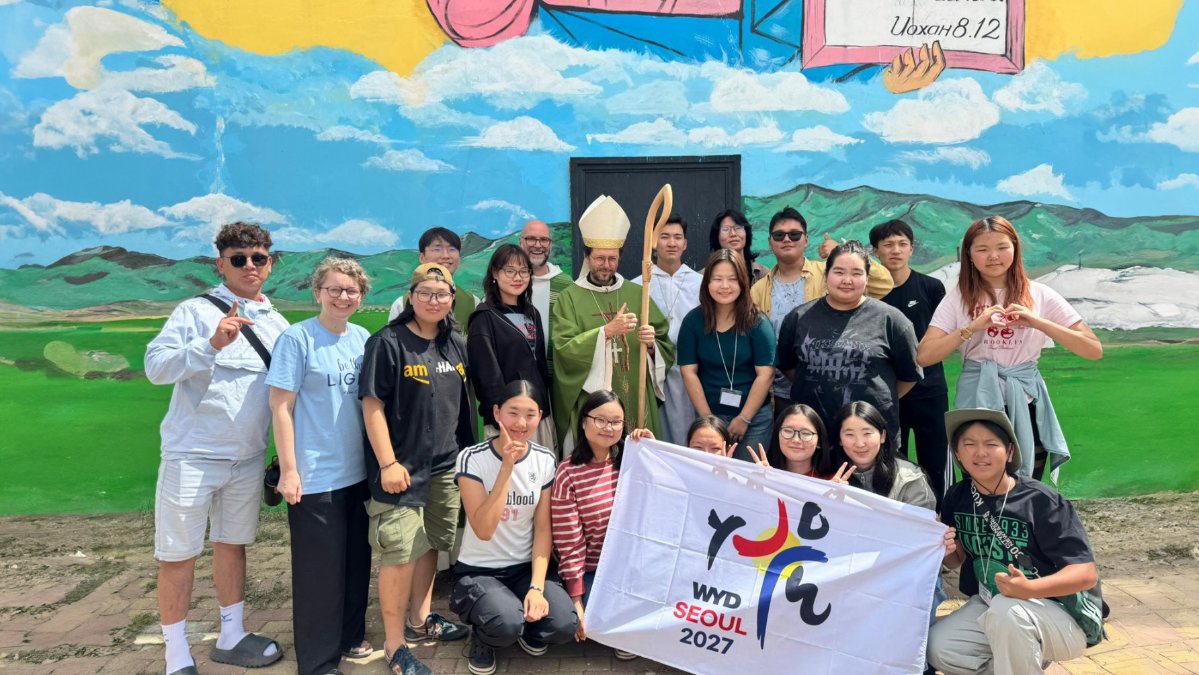
Mongolian Youth for Faith and Community in Seoul
------------------------
(Originally published by the Catholic Peace Broadcasting Corporation on August 28, 2025. Reposted with permission.)
------------------------
ULAANBAATAR—Catholicism is a tiny minority in Mongolia, accounting for just 0.04 percent of the population—about 1,450 people. Yet at St. Sophia Cathedral, on the western edge of the capital, the church has become a refuge for young people, many of them not Catholic at all.
From Aug. 1 to 5, a Korean delegation led by the Rev. Cho Dong-won of the Catholic University of Korea visited the cathedral to promote World Youth Day, which Seoul will host in 2027. The group included Park Chan-hee, a seminarian with the Seoul Archdiocese, and Lim Jae-jin, a volunteer for the global gathering.
The visitors joined a youth camp at the cathedral, located in Songinokhairkhan, one of Ulaanbaatar's poorest districts. More than half of the participants had not been baptized—a reflection of the cathedral's unusual role in the community. Beyond worship, it provides meals, laundry services, and showers for children who otherwise go without.
“There are children who cannot count on even one meal a day,” said the Rev. Sanja-Jav, Mongolia’s only native-born Catholic priest. “The church gives what families cannot.”
Attendance at Mass hovers around 40 to 50 each week, but only about 14 baptized youths participate regularly. Father Sanja-Jav liked his mission to the biblical parable of the sower. “We are planting seeds in the friends who come here now,” he said.
The Korean delegation's presentation about World Youth Day stirred excitement among the young Mongolians. It will be the first time the Catholic gathering is held in a non-Catholic majority country. Questions came quickly: Could the unbaptized attend? Would English or Korean be required? Where would they stay? What about visas?
One teenager, Nomin, 16, who had taught herself Korean by watching dramas, asked whether BTS might make an appearance. Afterward, groups of young people lingered to discuss what the event could mean for them.
“I definitely want to meet the pope in Korea with my friends,” said Varkhas, 26, his face lighting up at the prospect of joining Catholic youth from around the world. Another participant, Narangood, 16, who goes by the Christian name Moses, said he was drawn to the World Youth Day logo and hoped to try on a hanbok, a traditional Korean garment.
Money remains a formidable barrier. Only two Mongolians managed to travel to last year's gathering in Lisbon because of the cost. “The Mongolian church is small, but the faith of young people is clearly growing,” Father Cho said. “It would be good if Korea could provide both spiritual and material support.”
On Aug. 4, the Korean group also met with Cardinal Giorgio Marengo, who leads the Vatican mission in Mongolia. He said young Catholics there were “thirsting for deep faith experiences” and that the Seoul gathering would help them understand that “the Catholic Church is truly universal.”